
The Anatomy Student’s Nightmare: 206 Bones, One Impossible Test
Picture this: It’s 2 AM, you’re hunched over a plastic skeleton in the medical library, and your anatomy practical exam is in six hours. The femur bone you’ve been staring at for twenty minutes might as well be speaking ancient Greek. Your highlighter has bled through three pages of your anatomy textbook, but when you close your eyes, all you see is a blur of Latin names that sound like pharmaceutical commercials.
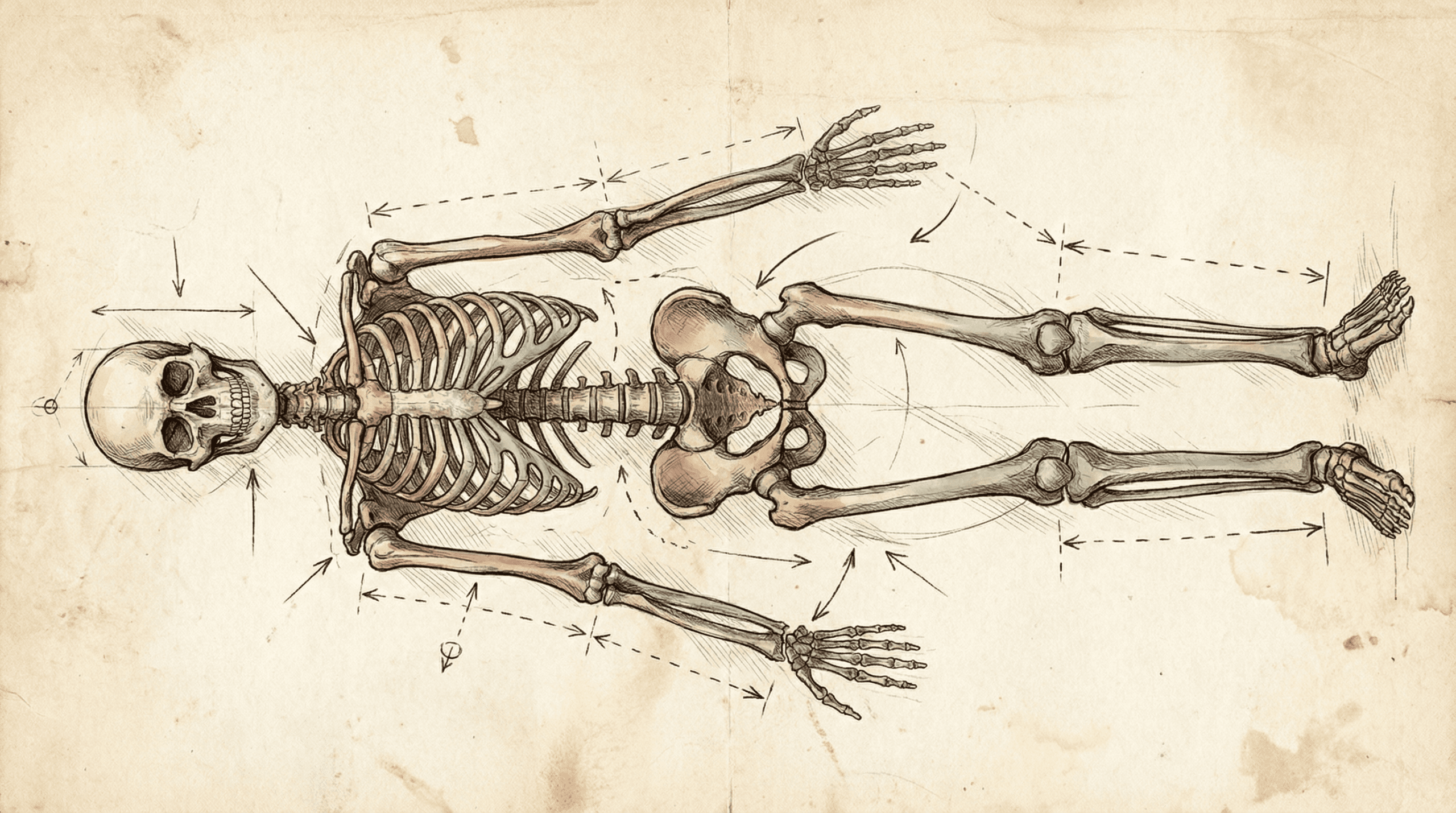
I’ve been there. Not as a medical student, but as someone who once believed memorizing large amounts of information was about grinding through endless repetition until something stuck. The human skeleton has 206 bones—accounting for about 15% of your body weight—and traditional study methods treat each one like an isolated fact to be hammered into your brain through sheer force.
Here’s what changed everything for me: discovering that ancient Roman orators had already solved this problem two thousand years ago.
The Hidden Cost: Why Poor Bone Memorization Sabotages Your Medical Career
When I first started working with pre-med students struggling with anatomy, I thought their problem was simple: they needed better flashcards. I was wrong.
The real cost of poor bone memorization goes far beyond failing one exam. Sarah, a nursing student I worked with, had to retake anatomy twice—costing her nearly $8,000 in additional tuition and delaying her graduation by a full semester. But the financial hit was nothing compared to the psychological damage.
“I started questioning whether I was smart enough for healthcare,” she told me six months later, after finally mastering the material using the techniques I’m about to share with you.
Weak anatomical foundations create a domino effect throughout medical education. When you reach advanced courses like pathophysiology or clinical rotations, bone names resurface constantly. The physician who fumbles identifying the scaphoid bone during a patient examination isn’t just embarrassing themselves—they’re potentially missing a commonly overlooked wrist fracture.
Students typically spend three to four times longer studying anatomy than necessary, not because the material is inherently difficult, but because they’re using memorization methods that fight against how human memory actually works. When you encounter bone names repeatedly in clinical settings, proper foundational knowledge can boost retention by 50-70%. Without it, every encounter feels like learning the information for the first time.

Why Common Study Methods Leave You Memorizing Air
The Rote Repetition Trap
Most students attack bone memorization the same way they’d prepare for a vocabulary quiz in middle school: repetition until it sticks. I spent three months watching my neighbor’s pre-med son recite “frontal, parietal, temporal, occipital” like a mantra every morning. Two weeks after his exam, I asked him to point out the temporal bone on a diagram. He couldn’t do it.
Flashcard drilling creates what cognitive scientists call “recognition without recall.” You might recognize the correct answer when you see it, but when faced with an actual bone specimen during a practical exam, your mind goes blank. The isolated facts have no context, no meaning, no connection to anything else you know.
The Highlighting Delusion
I used to highlight everything. Anatomy textbooks became rainbows of colored ink that made me feel productive without actually learning anything. The problem with passive reading and highlighting is that it creates false confidence—what psychologists call the “fluency illusion.”
When you read highlighted text multiple times, it feels familiar. Your brain mistakes this familiarity for knowledge. But visual recognition isn’t active recall. When you need to identify bones during a practical exam, there are no highlighting colors to guide you.
The “Cram and Pray” Method
Last-minute memorization doesn’t just fail because of time pressure—it actually works against your brain’s biology. When you’re stressed, your body releases cortisol, which impairs memory consolidation in the hippocampus. The very act of cramming under pressure makes it harder for your brain to form the connections you need.
I learned this the hard way during my own academic years. The information I desperately tried to stuff into my brain the night before an exam would vanish completely within 48 hours, as if I’d never studied it at all.
The Ancient Wisdom: How Roman Orators Memorized Entire Speeches
Marcus Aurelius governed the Roman Empire while simultaneously writing Meditations—one of history’s most influential philosophical works. He did this without computers, smartphones, or even reliable writing materials during his military campaigns. How?
The same memory techniques that allowed Cicero to deliver three-hour speeches without notes, that enabled ancient Greek scholars to memorize entire epic poems, that helped Roman lawyers remember complex legal arguments spanning days.
They used the Method of Loci, better known today as the Memory Palace technique.
Here’s how it worked: Cicero would mentally walk through his house, placing different parts of his speech at specific locations. The entrance hall might contain his opening argument, the kitchen his evidence, the bedroom his emotional appeal. When delivering the speech, he’d simply take the same mental walk, retrieving each section in perfect order.
“Confine yourself to the present.” – Marcus Aurelius
This Stoic principle applies perfectly to memory work. Instead of overwhelming yourself with all 206 bones at once, you focus on building one strong association at a time. The Stoics understood that excellence comes from working with human nature, not against it.
What’s remarkable is how perfectly these ancient techniques align with modern neuroscience. We now know that memory works through association and visualization—exactly what Roman orators figured out through pure observation and practice two millennia ago.

The Modern Method: Mnemonics + Visualization + Stoic Discipline
After working with hundreds of anatomy students, I’ve developed a three-pillar system that combines ancient wisdom with modern understanding of how memory works.
Pillar 1: Evidence-Based Mnemonics
Instead of trying to memorize random Latin names, you create memorable phrases that capture the sequence and characteristics of bone groups. These aren’t childish tricks—they’re sophisticated encoding strategies that give your brain multiple retrieval pathways.
Pillar 2: Visual Memory Palaces
You place bones in familiar spatial locations, leveraging your brain’s incredible ability to remember places and visual scenes. This creates the spatial context that pure repetition lacks.
Pillar 3: Stoic-Inspired Daily Practice
Consistency over intensity. The Stoics believed in daily practice of philosophy, and the same principle applies to memory work. Twenty minutes of focused practice beats four hours of cramming every time.
This combination works because it activates both your verbal and visual memory systems simultaneously. Instead of one weak pathway to each piece of information, you create multiple strong connections. When one pathway fails during an exam, others remain accessible.
Step-by-Step: Your 30-Day Bone Mastery System
Week 1: Foundation and Axial Skeleton
The axial skeleton contains 80 bones—everything along your central axis from skull to pelvis. This is where most students get overwhelmed, but it’s actually the perfect place to start because these bones have clear anatomical relationships.
Days 1-2: Master the Big Picture
Learn the fundamental division: 80 axial bones versus 126 appendicular bones. The axial skeleton includes 29 cranial and facial bones, 26 vertebral bones, and 25 rib cage bones. Don’t memorize individual names yet—just understand the organization.
Days 3-4: Vertebral Column Victory
This is where the magic happens. Instead of trying to remember “7 cervical, 12 thoracic, 5 lumbar” as abstract numbers, use this mnemonic: “Cereal at 7, Tasty lunch at 12, Light dinner at 5.”
When I first taught this to Jessica, a physical therapy student, she laughed and said it was too simple. Three weeks later, she texted me from her practical exam: “Cereal, lunch, dinner just saved my grade.”
Days 5-7: Skull Bones Memory Palace
Walk through your home and assign skull bones to specific locations. I put the frontal bone at my front door (obvious association), the temporal bones at my kitchen clock (temporal = time), and the occipital bone at the back door (occiput = back of head).
Week 2: Upper Extremity Focus
The Carpal Bone System
This is where students either breakthrough or break down. Eight small bones in a specific arrangement that you absolutely must know for any healthcare career.
Proximal row (closest to forearm): “Some Lovers Try Positions That They Can’t Handle”
– Scaphoid, Lunate, Triquetrum, Pisiform
Distal row (toward fingers): “Here Comes The Thumb”
– Trapezium, Trapezoid, Capitate, Hamate
The key insight: the trapezium actually articulates with the thumb, so “Here Comes The Thumb” isn’t just a memory device—it’s anatomically meaningful.
Memory Palace for Arms and Shoulders
I place the humerus in my living room (it’s the largest upper limb bone, so it gets the largest room), the radius and ulna on my staircase banister (they run parallel like the banister rails), and the scapula on my back porch (scapula = shoulder blade = back of shoulder).
Week 3: Lower Extremity Mastery
Tarsal Bones and Clinical Relevance
Seven tarsal bones form your foot’s architecture. Unlike the carpal bones, these have more size variation, making visualization easier.
The talus sits on top of the calcaneus (heel bone)—imagine a talent show performer balancing on a calculator. The navicular looks like a boat (naval connection), and the three cuneiform bones are literally wedge-shaped.
Integration with Function
This week, start connecting bones to their clinical significance. The fifth metatarsal has a notorious fracture pattern called a “Jones fracture.” The femur is the body’s longest and strongest bone because it bears your entire body weight.
Week 4: Integration and Systematic Review
The Kevin Patton Five-Part System
Anatomy educator Kevin Patton recommends learning each bone through five characteristics: site (location), shape, relations (what it connects to), attachments (muscles and ligaments), and blood supply.
This isn’t about memorizing five times more information—it’s about creating five times more retrieval pathways. When you understand that the scapula provides attachment points for 17 different muscles, the name becomes meaningful rather than arbitrary.
Spaced Repetition Schedule
– Day 22-24: Review Week 1 material (axial skeleton)
– Day 25-27: Review Week 2 material (upper extremity)
– Day 28-30: Mixed practice with all 206 bones
The spacing is crucial. Your brain needs time between practice sessions to consolidate the connections you’ve built.
Frequently Asked Questions
How long does it really take to memorize all 206 bones?
With focused daily practice using these techniques, most students can achieve solid recall of all 206 bones within 30-45 days. That’s 30 minutes per day, not hours of grinding. Compare this to traditional cramming, where students spend weeks feeling frustrated and still forget everything within days of their exam. The key difference is building meaningful associations rather than relying on repetition alone.
What if I’m terrible at visualization and can’t picture memory palaces?
I hear this concern constantly, and here’s the truth: you don’t need vivid mental imagery to use these techniques successfully. Many of my most successful students describe their memory palaces as “fuzzy” or say they “sense” the locations rather than see them clearly. The spatial relationships matter more than crystal-clear visualization. Start with places you know intimately—your childhood home, your current apartment, your daily commute.
Will this approach help with detailed bone markings and processes?
Absolutely. Once you have the basic bone names solidly memorized, you can extend the same techniques to learn tubercles, fossae, processes, and other anatomical landmarks. For example, the greater trochanter of the femur becomes “the great truck driver” in your memory palace—a big, burly character who lives at the top part of your femur location. The associations become more detailed, but the method stays the same.
How do I maintain what I’ve learned long-term?
The beauty of this system is that proper initial encoding makes retention much easier. Schedule brief review sessions: weekly for the first month after initial learning, then monthly, then every few months. When you encounter these bones in clinical contexts later, the associations will reinforce automatically. Many students tell me they still remember their carpal bone mnemonics years later, even without deliberate practice.
What are some effective mnemonics for memorizing other bone groups?
Beyond the classics I’ve shared, you can create personal mnemonics that resonate with your own experiences. For facial nerve branches, many students love “To Zanzibar By Motor Car” (temporal, zygomatic, buccal, marginal mandibular, cervical). For the brachial plexus organization, try “Rugby Teams Don’t Cover Bruises” (roots, trunks, divisions, cords, branches). The most effective mnemonics often incorporate humor or personal meaning—don’t be afraid to get creative.
Are there interactive methods to practice bone identification?
Yes, but use them strategically. Online bone identification quizzes and anatomy apps work best after you’ve built your initial memory framework using the techniques above. Physical bone models remain superior to digital images for developing true spatial understanding. Practice palpating bones on yourself and others when possible—this adds kinesthetic memory to your visual and verbal associations.
Your Next Action: Start With Just 8 Bones
Forget about all 206 bones for now. That overwhelming number is part of why traditional methods fail.
Instead, focus on mastering just the 8 carpal bones using the mnemonics I shared: “Some Lovers Try Positions That They Can’t Handle” for the proximal row, and “Here Comes The Thumb” for the distal row.
Spend 10 minutes tonight before bed walking through these associations. Picture the bones in your wrist as you recite the phrases. Feel the connection between “Here Comes The Thumb” and the actual movement of your thumb.
Tomorrow morning, test yourself without looking at any materials. Can you name all 8 bones in order? Can you identify which row each belongs to?
Master these 8 bones first, then return to build your complete skeletal knowledge systematically. Success breeds success, and proving to yourself that these techniques work will give you the confidence to tackle the remaining 198 bones with enthusiasm rather than dread.
Guided Practice
Memory Palace Practice
Close your eyes and follow along with this guided practice.
Find a quiet place, close your eyes, and follow along.