
The Ancient Art of Memory Palaces: How Cicero Delivered 6-Hour Speeches Without Notes
Picture this: You’re standing before fifty colleagues, armed with months of research and a presentation that could define your career. Then it happens—your mind goes completely blank. The key point you rehearsed twenty times? Gone. The statistic that proves your argument? Vanished.
This wasn’t a problem for Marcus Tullius Cicero. He regularly delivered six-hour speeches to the Roman Senate—without a single note, teleprompter, or backup slide deck. His secret wasn’t superhuman intelligence or photographic memory. It was a technique so powerful that modern memory athletes still use it to memorize entire decks of cards in under twenty seconds.
We’ve traded our mental sharpness for smartphone dependency, and the cost is higher than most realize.
The Hidden Epidemic: How Memory Weakness Is Sabotaging Your Success
Your memory problems aren’t just embarrassing moments—they’re career killers.
The average person forgets 70% of new information within 24 hours without active recall practice, according to research validating Hermann Ebbinghaus’s original forgetting curve studies. But here’s what the statistics don’t capture: the compound effect of memory weakness on professional advancement.
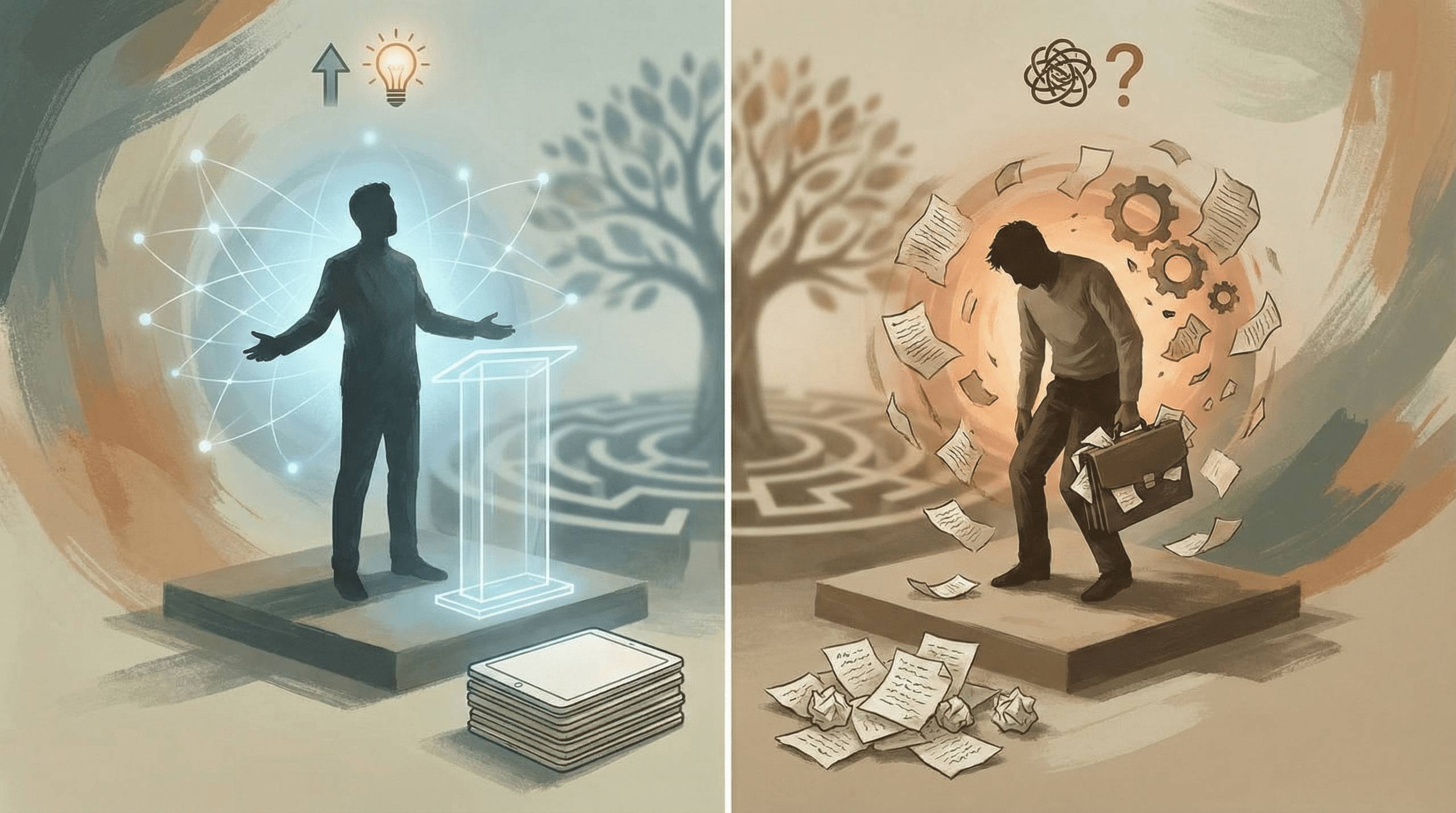
Consider Sarah, a marketing director who lost a $2 million client after forgetting crucial details from their previous meeting. Or David, passed over for promotion because he couldn’t recall quarterly figures without constantly checking his phone during board meetings. These aren’t isolated incidents—they’re symptoms of a systematic problem.
Memory weakness creates a vicious cycle. Poor recall leads to increased stress, and sleep-deprived individuals show a 40% reduction in the ability to form new memories. The anxiety about forgetting makes forgetting more likely.
The professional consequences stack up fast:
- Leaders who can’t recall names, figures, or key details lose credibility instantly
- Constant note-checking during conversations signals incompetence
- Important insights from books, courses, and meetings evaporate before implementation
- Decision-making suffers when relevant information isn’t mentally accessible
We’re not just forgetting facts—we’re forgetting our potential.
Why Every “Memory Improvement” Method You’ve Tried Has Failed
Most memory advice is built on three dangerous misconceptions that guarantee mediocre results.
Misconception #1: “Just repeat it more”
Rote repetition hits diminishing returns quickly. Your brain needs novelty and connection, not mindless drilling. That’s why cramming fails spectacularly—and why you can’t remember yesterday’s meeting details despite reviewing them multiple times.
Misconception #2: “Use this pre-made system”
Generic memory palaces and one-size-fits-all mnemonics ignore a crucial finding: researcher-provided virtual palaces consistently underperform compared to personally familiar locations. Jan-Paul Huttner’s recent research confirmed that pre-designed loci work for trivial information but crumble under real-world pressure.
Misconception #3: “Technology will save you”
Digital note-taking and reminder apps are memory crutches that weaken your natural capacity. Each time you outsource recall to a device, you reinforce the belief that your mind can’t be trusted. The result? Mental atrophy disguised as efficiency.
The truth is simpler and more empowering: You don’t need a better memory. You need a better method.
How Ancient Romans Conquered Information Overload
Cicero faced the ultimate high-stakes memory challenge. Roman law prohibited written notes during Senate speeches, yet political survival demanded flawless recall of complex legal arguments, historical precedents, and rhetorical flourishes—sometimes for six hours straight.
His solution became one of history’s most powerful learning techniques.
“The memory is a treasure to which we must commit the things we value most.” — Cicero
The Method of Loci (memory palace technique) emerged from a profound insight: our brains didn’t evolve to memorize abstract information, but we’re extraordinary at remembering locations. Ancient Greek poet Simonides discovered this after surviving a building collapse—he could identify victims by recalling exactly where each person had been sitting.
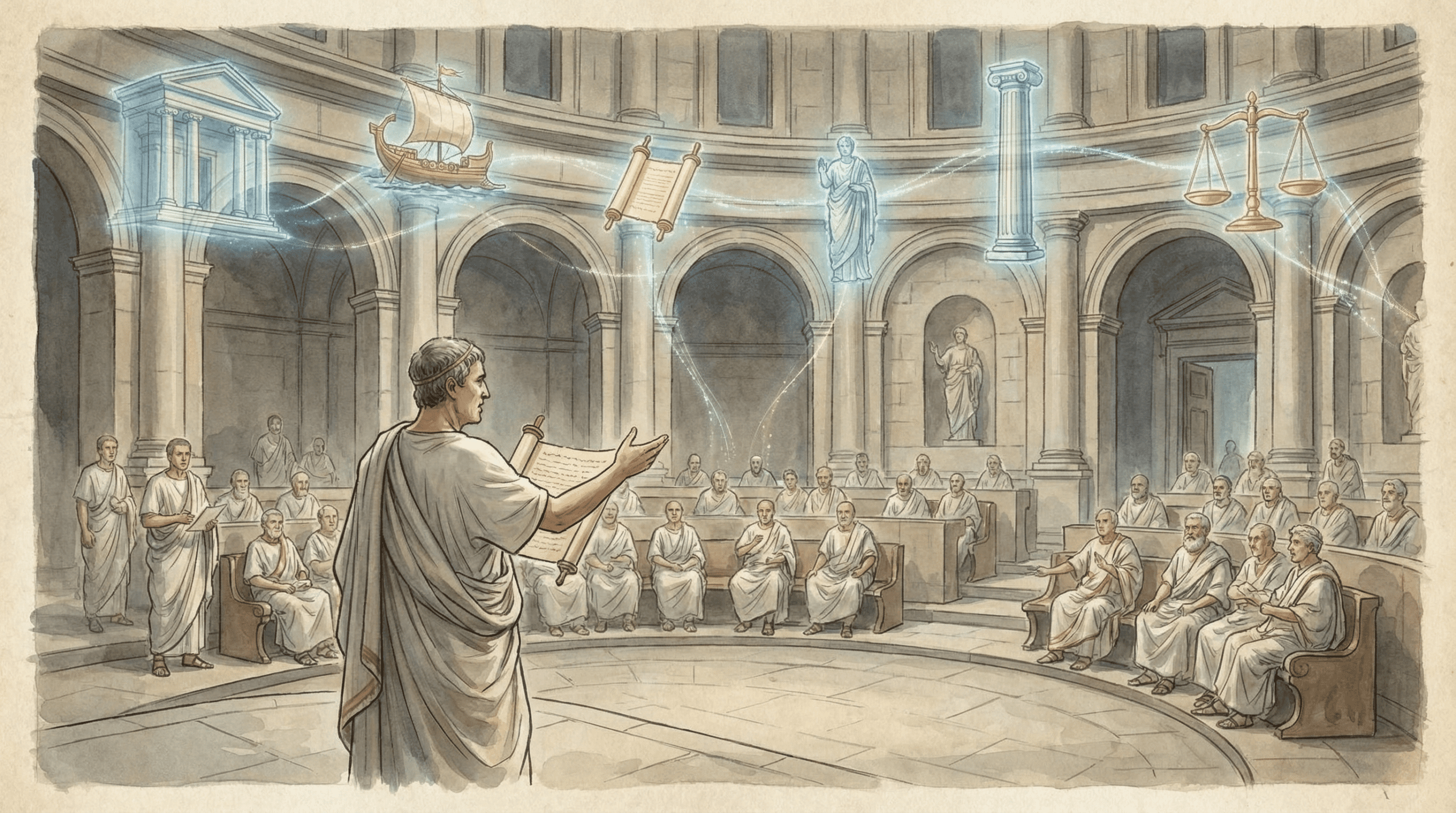
Roman orators refined this into a systematic approach. They’d mentally walk through familiar buildings, placing key arguments at specific locations. When delivering speeches, they’d take the same mental journey, collecting their perfectly organized thoughts.
The Stoic dimension was crucial. Memory mastery wasn’t about showing off—it was about intellectual virtue and preparation excellence. As Marcus Aurelius wrote in his Meditations, “The mind that pursues the good, whether it succeeds or not, is honored by the very attempt.”
Eleanor Maguire’s neuroscience research reveals why this worked: 9 of 10 elite memorizers use memory palaces, showing distinct brain patterns from practiced spatial memory use. They’re not born with superior genetics—they’ve trained their minds systematically.
The Science Behind Perfect Recall
Modern research has validated what Cicero knew intuitively: the memory palace technique improves recall by up to 2.9 times compared to rote memorization.
But the breakthrough findings go deeper.
A 2022 study using optimized VR-based memory palaces found participants improved recall by 22.2% after just one repeat session. The key insight? Familiar, immersive environments—like apartments rather than abstract geometric spaces—create stronger memory anchors.
Here’s what happens in your brain:
Your hippocampus, evolved for spatial navigation, becomes a filing system for abstract information. High-imageability words and vivid mental pictures create robust neural pathways that resist forgetting. Memory athletes can memorize a shuffled deck of cards in under 20 seconds using these principles.
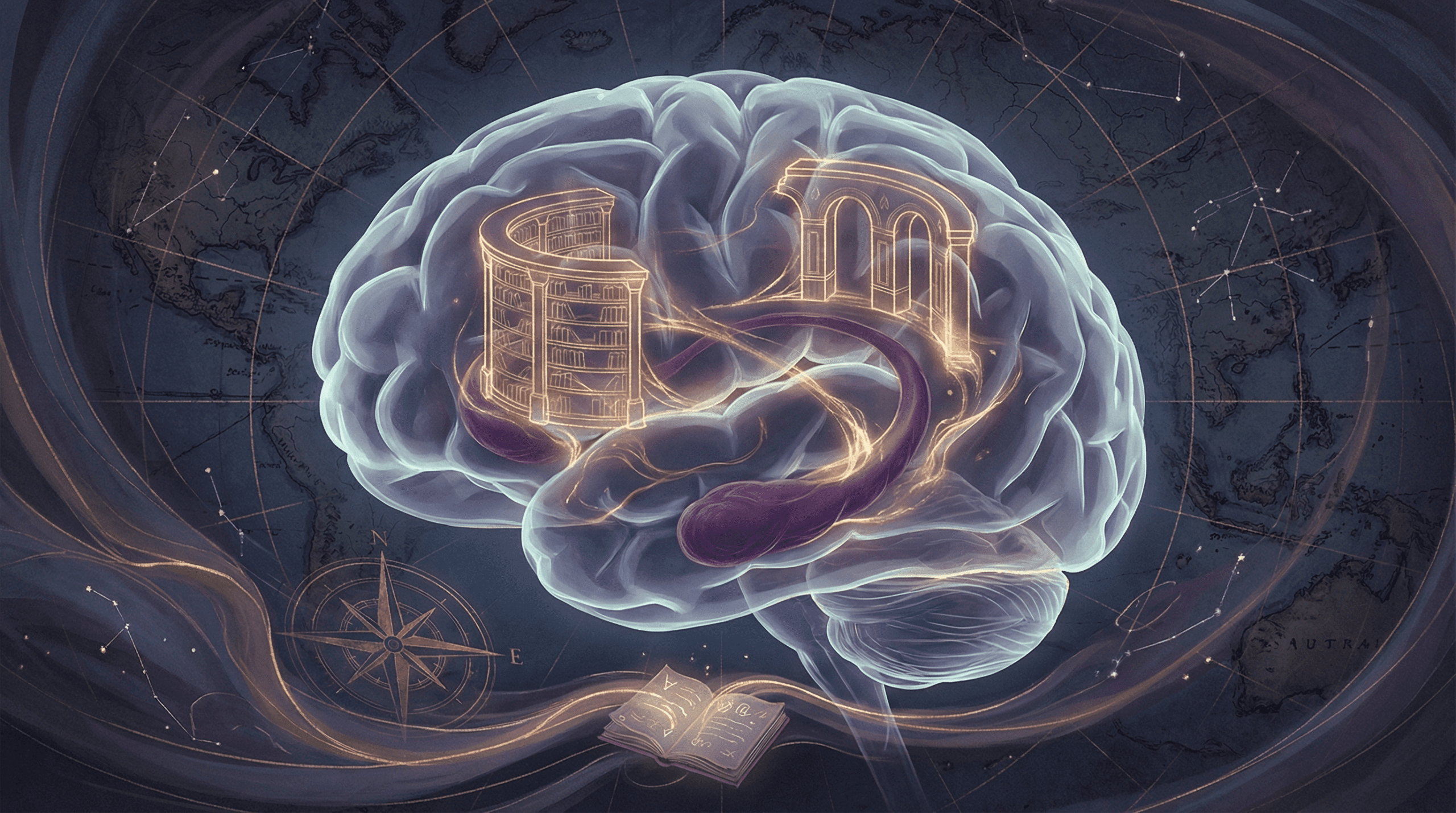
The method works because it leverages three cognitive strengths simultaneously:
- Spatial memory: We remember locations with extraordinary precision
- Visual processing: Images stick better than words or numbers
- Sequential organization: Mental journeys provide natural information structure
Medical students using memory palaces for endocrinology consistently outperformed controls, with 100% of participants rating the technique helpful for both memory and understanding. This isn’t just memorization—it’s comprehension through organization.
Build Your First Memory Palace in 15 Minutes
Stop overthinking this. You already possess the only requirement: familiarity with physical spaces.
Step 1: Choose Your Foundation
Pick a location you know intimately—your home, daily commute, or workplace. Familiarity trumps everything. Your childhood bedroom beats a generic “memory mansion” every time.
Why this matters: Your brain already has rich, automatic spatial knowledge of familiar places. You’re not creating new pathways—you’re repurposing existing ones.
Step 2: Map Your Route
Walk through your chosen space mentally, identifying 10-15 distinct objects or locations in a logical sequence. Kitchen counter → refrigerator → sink → stove → dining table, for example.
Critical detail: The route must be unidirectional and specific. “The kitchen” is too vague. “The coffee maker on the counter beside the window” creates a precise anchor.
Step 3: Test the Empty Palace
Practice your route until it’s automatic. Close your eyes and mentally walk the path three times without placing any information. If you hesitate or get confused, refine the route before proceeding.
Step 4: Place Your First Information
Transform abstract information into vivid, exaggerated images. Memorizing a presentation about quarterly sales? Place a giant graph crushing your kitchen counter. Need to remember client preferences? Visualize them literally sitting at each location.
The bizarreness principle: Normal images fade. Ridiculous images stick. A tiny, polite graph won’t survive in memory. A massive, neon-colored chart crashing through your ceiling will.
Step 5: Walk and Retrieve
Take your mental journey, collecting information at each stop. If something doesn’t stick immediately, make the image more vivid or outrageous. Your memory palace should feel like a surreal art gallery, not a filing cabinet.
Practice example: Tomorrow’s agenda using your living room palace:
– 9 AM team meeting → Giant conference table blocking your front door
– 10 AM budget review → Calculator the size of your couch
– 2 PM client call → Oversized phone ringing on your coffee table
Within two weeks of daily practice, this will become second nature. Within a month, you’ll wonder how you ever functioned without it.
Frequently Asked Questions
How long does it take to build an effective memory palace?
Initial setup takes 15-30 minutes. Mastery requires 2-3 weeks of daily practice, but you’ll see immediate improvements. The 2022 VR study showed significant gains after just one repeat session.
Can this work for abstract concepts, not just lists?
Absolutely. The biggest misconception is that memory palaces only suit trivia or shopping lists. Medical students use them for complex physiological processes. Lawyers memorize case law. Executives recall strategic frameworks. The key is transforming abstract concepts into concrete, visual representations.
What if I’m not a “visual” or “spatial” person?
Everyone navigates space—you found your way to wherever you’re reading this. Spatial memory isn’t about artistic visualization; it’s about recalling locations and movements. If you can remember where you parked your car, you can build a memory palace.
How many palaces do I need?
Start with one. Master it completely before expanding. Eventually, you might develop specialized palaces for different subjects—one for work presentations, another for learning material, a third for personal goals. Memory athletes often use dozens, but one well-constructed palace can hold enormous amounts of information.
Won’t this take longer than just using notes?
Initially, yes. The upfront investment pays compound returns. After the first month, placing information in your palace becomes faster than writing notes. More importantly, the information stays accessible without external tools. You’ll spend less time re-reviewing and more time applying what you know.
What if I forget the palace itself?
This rarely happens with familiar locations, but if it does, simply rebuild using the same space. The neural pathways strengthen with each reconstruction. Think of it as renovating rather than demolishing—the foundation remains solid.
Your Next Step to Perfect Recall
Here’s your single, clear action for the next 24 hours: Choose one familiar location and map 10 specific spots within it.
Don’t overthink this. Your bedroom, your commute to work, your morning routine—any sequence you know well will work. Write down the route if it helps, but focus on creating vivid mental pictures of each location.
“The art of memory is the art of attention.” — Samuel Johnson
Tomorrow’s test: Use your new palace to memorize your daily agenda or this weekend’s grocery list. Notice how much easier recall becomes when information has a physical address in your mind.
Track your progress: Keep a simple log of what you memorize and how accurately you recall it after 24 hours. Most people see dramatic improvement within the first week.
The memory palace technique isn’t just about remembering more—it’s about thinking more clearly, learning more efficiently, and projecting the quiet confidence that comes from knowing your mind is a reliable tool rather than a leaky bucket.
Cicero delivered those six-hour speeches not because he had a superior brain, but because he had superior method. The same technique that helped him govern an empire can help you master your next presentation, ace your certification exam, or simply stop forgetting where you put your keys.
Your palace awaits. Start building.
Ready to master the complete system? Sign up for our Stoic Memory course. We cover the proven methods the ancients used, combined with new, modern methods that make memorizing 30x faster. It isn’t a trick, it’s just using technology to make the learning process streamlined.